Brain-Computer Interface Could Help Unresponsive ICU Patients Communicate
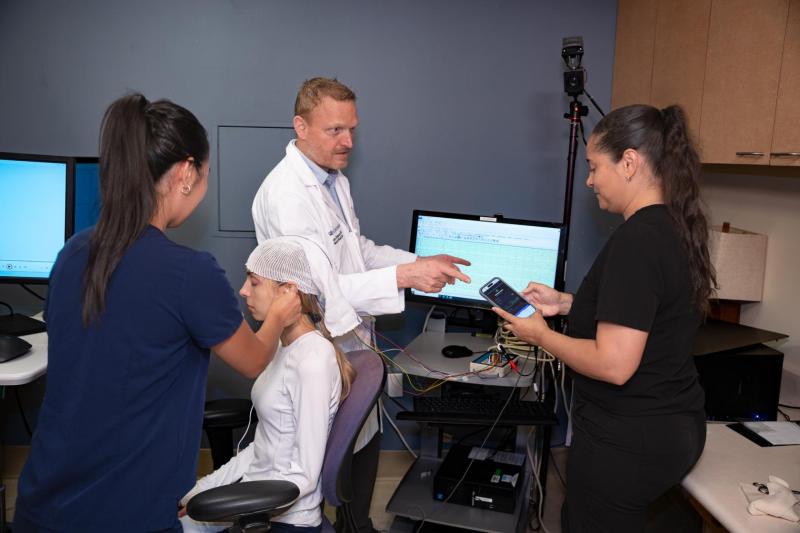
Image Credit: Rudy Diaz/Columbia University Irving Medical Center
Researchers at Columbia University have developed a noninvasive brain-computer interface that could eventually help unresponsive intensive care patients communicate with doctors and family members. In a study published on October 22, 2026, the team demonstrated that some patients with acute brain injuries could control the frequency of a beeping sound using their thoughts alone. The findings offer a potential new approach to communicating with patients who may retain consciousness but are unable to speak or move in response to questions.
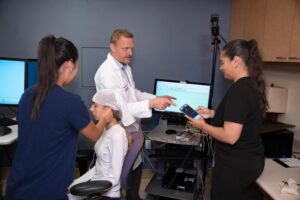
The technology relies on electroencephalography (EEG), which records electrical activity in the brain through electrodes attached to the scalp. The researchers connected EEG wires to patients’ heads and used a bedside computer to analyze their brain signals in real time. Participants listened to a beeping tone through headphones while a recorded voice instructed them to change its frequency by trying to open and close their hands. The system provided feedback as patients attempted the task, encouraging them when the tone changed and congratulating them when they reached the target.
The study involved 41 patients who were clinically unresponsive following acute brain injuries. After a short training period, approximately one-third were able to control the beeping tones through mental effort alone. This included all patients identified as having cognitive motor dissociation (CMD) through a separate examination. Notably, the patients demonstrated this ability within days of sustaining severe brain injuries, suggesting that the approach may offer a way to identify and engage some patients with preserved cognitive abilities early in their hospital stay.
The research builds on earlier work by Jan Claassen, a professor of neurology at Columbia University Vagelos College of Physicians and Surgeons and the study’s lead researcher. In 2019, his team used standard EEG technology and artificial intelligence to analyze the brain activity of unresponsive patients with brain injuries, detecting signs of hidden consciousness in 15% of them. Although these patients could not follow commands to blink, make a fist or move their toes, their brain activity suggested that they were attempting to comply but could not produce the required physical movements.
This condition, known as cognitive motor dissociation, reflects a disconnect between cognitive processes and the brain regions responsible for controlling muscles. According to the researchers, patients with CMD are more likely to regain consciousness and recover a significant degree of everyday functioning. However, techniques for identifying this condition are not yet available outside research studies.
“Research in the past decade by us and others has shown that many patients with acute brain injury who appear to be in a coma actually have some level of preserved consciousness, even though they are unable to speak or move their hands or eyes to communicate,” says Jan Claassen, MD, a professor of neurology at Columbia University Vagelos College of Physicians and Surgeons, who led the study.
Existing brain-computer interfaces have helped people with paralysis control mobility devices and enabled communication for some patients with neurodegenerative conditions such as amyotrophic lateral sclerosis (ALS). However, these approaches can involve implanting a computer chip on the brain’s surface, making them less suitable for patients who have recently suffered severe brain injuries. The Columbia team’s approach instead uses EEG equipment already employed in intensive care units, potentially making the technology easier to integrate into clinical environments.
“That’s why our system is a major advancement,” Claassen says. “EEG is used in clinical practice every day in the ICU. The only sophisticated part is the computer program we wrote, which analyzes the data in real time and modulates the feedback to the patient.”
The researchers acknowledge that the current system represents an early step rather than a fully developed communication tool. Patients and their families who participated in the study offered suggestions for improving the technology, including personalized features such as using the voice of a loved one and incorporating culturally relevant details. They also proposed functions that could help identify basic needs, including pain, hunger and awareness.
“Our goal is to refine the system so that patients can tell their doctors and loved ones how they are feeling—if they are in pain or hungry, for instance—with more direct communication.”
If further development succeeds, the technology could eventually provide a communication channel for patients who are conscious but unable to express themselves through conventional means. The researchers see this as a potentially important development for intensive care, where recognizing a patient’s awareness and needs can be particularly challenging.
“Patients with hidden consciousness or cognitive motor dissociation are unable to show any expression or communicate in any way,” Claassen says. “I think that’s where our work can be fundamentally transformative.”The study, titled “Clinically unresponsive patients with acute brain injury activate a brain-computer interface,” was published on October 22 in the journal Brain. The research was conducted by investigators from Columbia University and NewYork-Presbyterian and received support from several organizations, including the National Institutes of Health, Paris Brain Institute America, the Canadian Institutes of Health Research, the Fondation du Centre hospitalier de l’Université de Montréal and the Royal College of Physicians and Surgeons of Canada.