TUM and NEURA Robotics Open Advanced Training Center to Make Robots Smarter
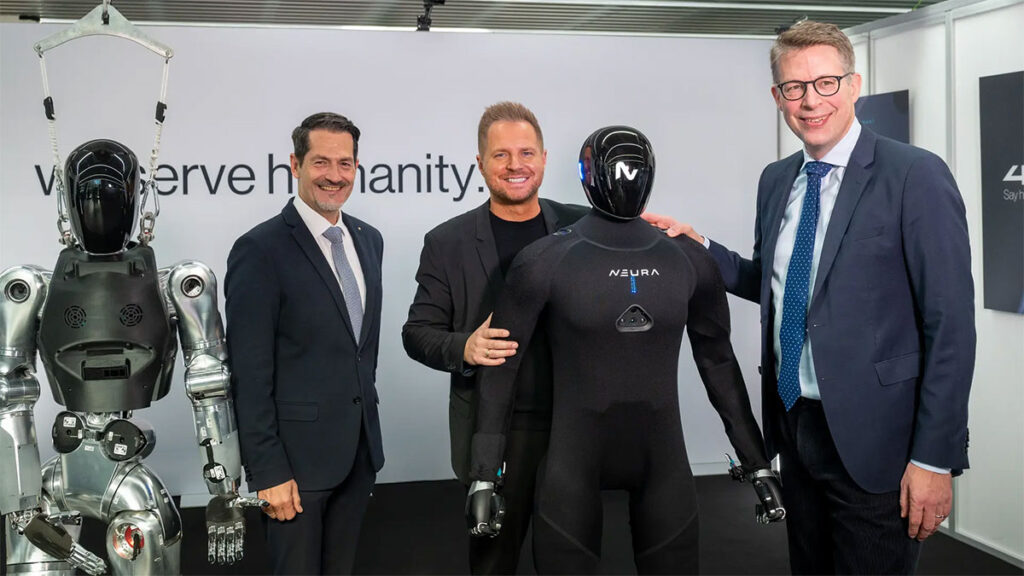
Image Credit: Andreas Heddergott / TUM
The Technical University of Munich (TUM) and NEURA Robotics have opened the TUM RoboGym, a new facility dedicated to training robots and advancing research into embodied artificial intelligence. Located at the LabCampus innovation hub at Munich Airport, the center is designed to help robots develop practical skills through physical interaction with their surroundings. Around 100 humanoid and service robots are initially expected to train in 48 dedicated cells, generating data intended to improve their safety, reliability and performance.
Unlike generative AI systems that learn from large volumes of information available online, embodied AI requires data gathered through physical interactions in the real world. Such training data remains limited, making dedicated facilities an important part of developing robots capable of performing practical tasks. At RoboGym, machines will learn and practise activities such as folding boxes, assembling components and operating tools in realistic environments.
The center combines its robotic training facilities with substantial computing resources for artificial intelligence development and computer simulations. Data generated during training will be collected in a curated cloud-based data lake, making it available for the development of physical AI models. The resource is intended to support research into robotic skills that can be applied across different situations, safer interactions between humans and machines, and more capable AI systems for robotics. The initial focus will be on industrial applications and intralogistics.
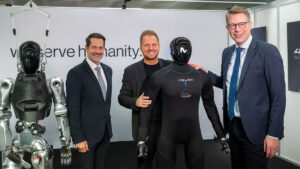
NEURA Robotics is contributing humanoid robots and infrastructure to the project. During the opening, the company also presented the next generation of its 4NE1 humanoid robot, which will subsequently become available at RoboGym. The facility will allow researchers to develop and test robotic capabilities while exploring how advances in AI can be translated into practical industrial solutions.
A central objective of the partnership is to bridge the gap between scientific research and commercially viable technology. Prof. Achim Lilienthal of TUM MIRMI, the university’s Institute of Robotics and Machine Intelligence, described close cooperation with industry as essential to this process. “Close, continuous and flexible collaboration with the robotics industry is essential for research in physical AI. It is the only way to systematically and rapidly develop research prototypes into market-ready products,” he said, describing RoboGym as a pioneering pilot project for TUM.
The initiative also reflects the potential role of intelligent robots in addressing practical challenges across different industries. Hubert Aiwanger, Bavaria’s Deputy Minister-President and Minister of Economic Affairs, highlighted their possible use in transporting materials, assembling components and handling physically demanding routine work. Such applications could reduce the burden on employees and allow them to concentrate on tasks that require human skills, particularly as businesses face shortages of skilled workers.
Bavarian Minister of Science and the Arts Markus Blume said the facility would help prepare robots for real-world use while strengthening the region’s technological capabilities. TUM President Prof. Thomas F. Hofmann likewise emphasized the significance of the collaboration, stating: “The TUM RoboGym is unique in Germany and Europe. Through our collaboration with NEURA Robotics, we are also sending a clear signal in support of Germany as an industrial base at a time of geopolitical uncertainty.”
For TUM MIRMI Executive Director and RoboGym Director Prof. Lorenzo Masia, the partnership offers an opportunity to combine the university’s research expertise with the capabilities of an industrial partner. “TUM MIRMI and NEURA Robotics are two partners with the potential to achieve great things together. Building on our world-leading scientific expertise, we can now work with a strong industrial partner to prepare concrete applications for the market. Our long-term goal is to create a dynamic robotics industry that can help drive growth in the German economy,” he said.
NEURA Robotics CEO David Reger also stressed the value of combining industrial knowledge with AI. He said: “Our companies hold knowledge that has been built up over generations. People know how to work materials, assemble components and master difficult processes. This knowledge is one of our greatest strengths in the age of Physical AI. With TUM, we are building a powerhouse for physical capabilities, where this knowledge becomes the foundation for new possibilities. The Mittelstand, in particular, should be able to help shape this future.
With the launch of the humanoid 4NE1 Gen 4, we are showing today which robots are ready for it: designed for series production, built for productive work and powered by Neuron AI, our own foundation model that learns from experience in the NEURA Gyms. Developed, built and trained in Germany, for the world.”The RoboGym forms part of a broader effort to strengthen cooperation between academic research and industry. By combining physical robot training, AI computing infrastructure and systematic data collection, TUM and NEURA Robotics aim to accelerate the development of machines capable of carrying out useful tasks in real working environments.